‘If God wanted us to watch verticals, He would have given us two eyes on top of each other!’
It’s a joke I like to make when the topic of aspect ratios comes up, but lately, the conversation has gotten much more serious. We are seeing a massive new trend of short, 1 to 2-minute stories filmed exclusively in the 9:16 vertical format to be viewed on your phone. It’s impossible to ignore the shift—especially with the recent news that even Netflix is testing vertical video features for mobile devices.
But as we scroll through these endless vertical feeds, we have to ask a thoughtful question: is this format actually good for visual storytelling?
Honestly, the 9:16 aspect ratio forces a claustrophobic frame. Who wants to watch feet-to-head shots all the time? It fundamentally constricts the visual language of a film. When the sides of your world are cut off, you lose the ability to establish the environment, give characters room to breathe, and capture the true emotion of a scene without awkward visual constraints.
If you want the full experience, the solution is simple: just turn the phone sideways!
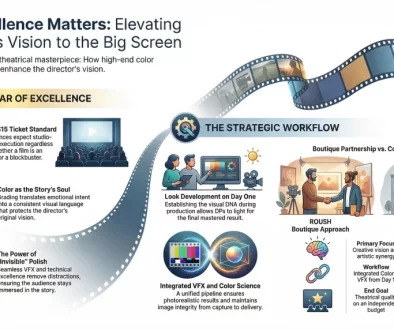
At ROUSH Media, our mission is to help filmmakers make stunning films. We believe that high-end color grading is a seamless blend of artistry and technical science, and we position it as a fundamental part of storytelling. The screen is our shared canvas. A wide, cinematic framing allows the Director of Photography to properly paint that canvas, using light and shadow to guide the audience’s eye and elevate the narrative.
Now, the irony here isn’t lost on me. While I am a massive advocate for traditional, stunning cinematic widescreen, our team actually provided the color grading for a TV show literally called Verticals! At the end of the day, our job is to act as the custodian of the DP and Director’s vision. If the creative choice is vertical, we will use the best of art and science to make it look incredible.
However, true excellence in the execution of your story must be on par with the studios. Whether you are grading a massive $200 million theatrical release or high-end streaming content, the goal is always to remove any visual distractions that might take away from the story. A restricted, unnatural frame can often be the biggest distraction of all.
When an audience pays for a premium experience, the excellence in the execution of your story matters. A wider aspect ratio gives you the power to build a beautiful, immersive visual language.
So, as platforms like Netflix experiment with vertical features, my advice to filmmakers remains the same: protect your story, build a beautiful visual world, and keep it widescreen if you can.
And to the viewers? Do the story a favor… just turn your phone sideways.